The History of Groot Constantia Wine Estate.
Commander Simon van der Stel of the Dutch East India Company (VOC) arrived at the Cape supply station in 1679. Estranged from his wife he arrived in the company of his children and sister-in-law, Cornelia Six. Back in the Netherlands van der Stel had gained a solid background in viticulture at his vineyards in Muiderbergh. There he learnt the art of wine and brandy making which he was soon to implement here in the Cape.
Commissioner Rijckloff van Goens, a former governor of Ceylon and Council Member of India, visited the Cape while recuperating from an illness. He recommended to the Chamber of Seventeen, the governing body of the VOC, that land should be granted to Simon Van der Stel. After a visit by High Commissioner Hendrik Adriaan van Rheede tot Drakenstein, Van der Stel received title to 891 morgen (about 2461 hectares) on 13th July 1685. The land stretched southwards to the neighbouring free burgher farms of Steenberg and Zwaanswyk and to the north it reached as far as the wooded area named The Hell.
Van der Stel named his farm Constantia. It is thought that Van der Stel named the farm after Van Goens's daughter in recognition of his help and support in obtaining the farm land. Another theory is that the farm was named after the VOC ship "Constantia" which, with the "Alphen" was anchored in Table Bay.
The original Manor house appears to have been designed in a late Dutch Renaissance style. The traveller Francois Valentijn (1666-1727) described it as a double-storey dwelling with two or three steps leading to a front room or voorhuis, paved with white marble and red stone. There was a big pentagon in the shape of the Castle of Good Hope tiled into the centre of the floor. On both sides of the voorhuis were grand rooms, also with white marble floors.
A vineyard is born
Agricultural activities on Constantia included viticulture, and Constantia wine became renowned in Europe. In 1709 there were 70,000 vines on the farm and Van der Stel produced 5,630 litres of wine. Despite the size of Constantia, Simon Van der Stel seemed to have a big desire for land. In 1693 he acquired the neighbouring farm Witteboomen and in 1699 the farm Boschheuvel (presently Bishopscourt), the latter of which he soon disposed. In 1699 he retired as governor and acquired Zeekoeijenvalleij.
By 1709 Van der Stel owned 60 slaves (originating from Bali, Batavia, Brazil, Canary Islands, Cape Verde, Ceylon, China, India, Madagascar, and some of course were Cape born). These slaves worked in the vineyards and wheat and barley fields.
In 1712 Simon van der Stel made his last will in favour of his five children. Constantia should be sold two years after his death and some of the slaves were to be set free. Ironically, by 1712 his sons Willem Adriaan and Frans were no longer living in the Cape. In 1797 Willem Adriaan had been recalled to the Netherlands because of his corrupt and monopolistic activities as Cape governor.
On 24th June 1712 Simon van der Stel died at the age of 73. Then in 1714 Constantia was subdivided and sold by way of auction. Pieter de Meijer bought two parts, Bergvliet and Klein Constantia. Captain Oloff Bergh bought the part (later known as Groot Constantia) on which the Van der Stel buildings were situated.
On 13 November 1716 Oloff Bergh officially took possession of Groot Constantia. He was born in Goteborg, Sweden in 1643. He joined the VOC in 1665 spending a few years as a soldier in Ceylon and arrived as a sergeant at the Cape in 1676. He met Anna de Koningh at the Cape; they fell in love and got married. The union produced 11 children. Bergh must have done very little about the viticulture on the farm. His neighbour, Johannes Colijn of Klein Constantia (later De Hoop op Constantia), produced quality wines that drew overseas attention and became well known as Constansia Wines.
In 1724 Oloff Bergh died and his wife Anna de Koningh became the first female owner of Groot Constantia. She was born in Batavia and was one of three children from the slave Angela of Bengal.
When she died in 1734 Carl Georg Wieser became the new owner of Groot Constantia on 9th August 1734, he proceeded to further develop Groot Constantia. He increased the viticulture activities and by 1751 had 60,000 vines from which 16,890 litres of wine were produced.
Wieser died in 1759 and his stepson, Jacobus van der Spuij, bought Groot Constantia. On the 8th of June that same year van der Spuij also had to borrow money toward the purchase of the farm and the additional expenses of slaves and wooden caskets. Like his predecessors, he had to supply wine to the VOC which resulted in financial problems. In spite of this, by 1772 it appeared that Groot Constantia produced a more superior quality of wine to Klein Constantia, increasing the purchase value of their wines. Surprisingly van der Spuij never involved him self with the actual production of the wine; rather he had a slave who acted as cellar master during his period of ownership.
On 15 January 1778 the farm was sold to Jan Serrurier - three months later Jacobus van der Spuij died.
Hail damage to the vineyards and the resulting poor crop contributed to the poor state of the farm and made the ownership of Serrurier short-lived. Eleven months after he bought it, the farm had a new owner and the fortunes of the farm were to change.
The Cloete Era
Hendrik Cloete, from the farm Nooitgedacht near Stellenbosch, became the new owner in December 1778. He was married to Hester Anna Lourens and they had eleven children. Cloete also purchased all the moveable property and the 16 slaves originally belonging to Van der Spuij. He added another 16 slaves to help clear up the neglected farm. By 1792 all the new building work had been completed and the farm was given a whole new appearance.
Probably the first building to be erected was the wine cellar. It was set behind the homestead on the edge of the valley and on the central axis of the house.
The sculpture on the pediment of the wine cellar is believed to be the work of the German sculptor Anton Anreith (1754 -1822).It depicts fertility and, although Rococo in design, the sculpture blends well with the neo-classicism of the building. The date 1791 on the sculpture could indicate its year of completion, but another theory is that Hendrik Cloete commissioned it to commemorate the excellent grape harvest he had in that specific year. Whatever the reason, it is regarded as one of the most important sculptures in the country.
The row of outbuildings in front of the farmstead on the western side is known as the Jonkershuis complex. This is where the "Jonkheer" or oldest son of the farm owner would have lived. However, these buildings probably served as slave quarters and stables, and were most probably called "Jongenhuijs" meaning slave house. They also had wolf-nose gables: the present bell gable changes were made in the early 19th century.
The gallery of the Jonkershuis complex was widened and the original pitched and flat roofs replaced with a pitched thatch roof. New stone floors were also put in the house, but it is not clear what they looked like.
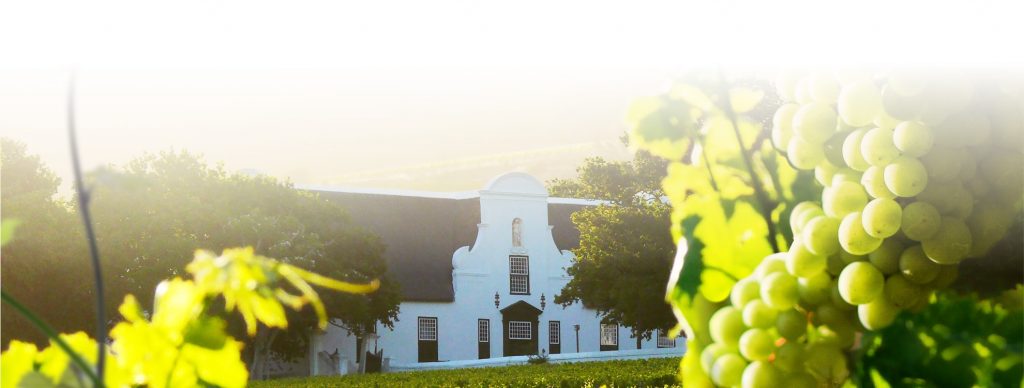
The slender gables of the Manor House were added, as well as the figure of "Abundance" in the niche of the main gable. The ornamental vases on the side gables were also added. As with the wine cellar, Thibault and Anreith are regarded as the architect and sculptor responsible for the work on the Manor House.
The oval-shaped pool northwest of the farmstead, with its sculpted figure of "Triton" half man half fish, son of Neptune was probably built at a later stage. The Inferior quality of its construction in comparison with the farms other buildings point to this. The original "Triton" was replaced with a fibreglass copy in 1985 in order to preserve the original.
New vines were also planted to replace the neglected ones and the VOC requested that Hendrik Cloete increase the farm's production. By 1780 he had already planted 10,000 new vines. From 1780 Hendrik Cloete made the wine himself. Apparently his new cellar was one of the best in the Cape.
He, too had to sell two-thirds of his wine to the VOC, but by 1794 he came to a better arrangement with them. After the British occupation of the Cape in 1795, he had to deliver wine to the British command at the Cape.
For Hendrik Cloete, only the name of the wine monopolist had changed.
In 1794 Hendrik's wife died and she was buried in the family graveyard at Groot Constantia. Hendrik Cloete left the farm to live at Nooitgedacht where he died, and his younger son, also Hendrik Cloete, took charge of Groot Constantia and became the eventual new owner.
Wines fit for a King
Like his father, wine deliveries to the Cape Government continued to be problematic. However, Hendrik Cloete had successes. He supplied Napoleon Bonaparte with wine while the latter was in exile on St. Helena from 1815 to 1821. In 1816 Hendrik Cloete sent wines as a gift to William I, King of the Netherlands, for whom he had great admiration.
Hendrik died on 29th September 1818. He left Groot Constantia to his wife.
Anna Catharina Scheller became the second female owner of a farm which measured about 624 hectares. In 1823 her son Johan Gerhard bought part of Groot Constantia - 376 hectares. His land was first known as De Hoop op Constantia but later became Klein Constantia. Anna's second oldest son, Jacob Pieter, and his wife, Catharina Cornelia van Reenen, lived with her.
Wine production averaged 16,890 litres and brandy 563 litres annually. Napoleon Bonaparte was still supplied with wine, until his death in 1821. It is said that his last request was to be served a glass of Constantia wine. Notable buyers of Groot Constantia wines included the Marquis of Hastings, the Governor of Ceylon and the Scottish author Sir Walter Scott (a close friend of Lady Anne Barnard). The supply of wine to the Cape Government went without a hitch: Lord Charles Somerset was the governor at the time.
On 3rd December 1824 Groot Constantia changed hands again, when Jacob Pieter bought the farm and its moveable property from his mother. From that date onwards the farm officially became Groot Constantia, to distinguish it from Johan Gerhard Cloete’s property, Klein Constantia.
Jacob Pieter undertook building operations to change the buildings according to his needs. The dining hall of the farmstead was divided with partition doors and a fireplace was added in one part. The kitchen wing was also extended. The gables of the Jonkershuis complex were replaced with bell gables.
Family, staff and slaves probably lived there. Amongst the staff were private tutors for the children, such as the artist, Henry Clifford de Meillon, who lived there in 1825.
Jacob Pieter still made wine according to his grandfather's methods, and sold it to many of his visitors and prominent local residents. Overseas orders poured in and King Louis Philippe of France was a customer in 1833, 1834 and 1835.
Disaster strikes the vineyards.
In 1859 disaster struck in the form of the wine disease "Oidium Tuckeri", popularly known as powdery mildew. Jacob's oldest son Hendrik treated the vines with sulphur and partly succeeded in combating the disease. In 1866 the dreaded "Pylloxera" disease struck the Cape vineyards, including those at Groot Constantia.
Phylloxera is a root louse that attacks the “vitis vinifera” grapevines, eventually causing their death. A massive infestation of Phylloxera took place in Europe and America at the same time, destroying millions of acres of grapevines. During the plague it was discovered that America's “vitis labrusca” grapevines were immune to Phylloxera. From that time onwards most “vitis vinifera” grapevines have been grafted onto “vitis labrusca” roots making the vinifera vines highly resistant to Phylloxera.
By 1872 Jacob Pieter was bankrupt and could no longer meet his obligations. He appeared in the Cape Supreme Court and was declared insolvent. Groot Constantia however was to remain in his estate until 1885. Jacob left the farm and went to live in Plumstead where he died in 1875. He was buried in the Groot Constantia graveyard.
Henry Clifford de Meillon was married to Maria Catharina Duckitt. After his mother's death in 1867 Henry, his wife Maria and their seven children moved from the Jonkershuis into the farmstead. Their eighth child was born two years later on the farmstead.
Phylloxera must have been a plague to the Cloete’s for a long time, because in 1875 Henry left for France to study remedies for the disease. He stayed there for ten years. Henry's son Freddie acted as farm manager, and his son Jacob managed the estate's office in Adderley Street, Cape Town.
Henry returned from Europe and it was decided to sell Groot Constantia by auction. On 1st October 1885 the Cape Government became the new owner, having bought the farm for a mere £5,275. When compared to the amount of £18,750 paid in 1824, the sad state of the vines on the farm was evident.
The Cape Government used the farm as an experimental wine farm. A setback occurred when Phylloxera invaded the farm in 1899. The American wild vine stock was used to combat the plague.
Just before Christmas 1925 a fire gutted the historic farmstead. This probably saved Groot Constantia because the government was forced to take a fresh look at the estate. The house was restored under the chairmanship of the architect Franklin Kendall. Alfred de Pass, from 1927 until his death in 1952, donated and bought objects for the Manor house and refurbished it.
In 1963 control of the farm was handed over to the Agricultural Technical Service. In 1969 the South African Cultural History Museum, presently part of Iziko Museums of Cape Town, became responsible for the running of the farmstead and historic “Cloete” wine cellar. During 1971 a wine museum was established in a part of the wine cellar by the South African Cultural History Museum. In 1974 this was closed and demolished. In 1975 Hoop op Constantia and part of Nova Constantia were consolidated with Groot Constantia. An adjoining property, Coleyn, followed in the early 1980s. The Groot Constantia Control Board was established in 1976 to take charge of the viticulture on the farm. In 1984 Groot Constantia and Hoop op Constantia were declared National Monuments. In 1993 ownership of the entire estate was transferred from the government to an independent company, named Groot Constantia Trust. The main aim of the Trust is to preserve and maintain the cultural heritage of the estate for posterity.
A Lost Treasure in Delaware Bay
Groot Constantia's place in history received another significant endorsement in 2004 when an American citizen picked up a piece of glass on the beach at Lewes, Delaware, on the east coast of America. The piece of glass had an inscription "Constantia Wyn" on it and American historians traced this artefact which was found among other porcelain items, to a ship that stranded in the Delaware Bay in 1774. The ship was a British supply ship named the Severn, which sank in the Delaware Bay after being hit by a storm. The wreckage was only discovered in 2004.
Unfortunately the bottle of Groot Constantia wine was broken during the storm and except for the engraved inscription, the bottle offered no other clue as to what had been inside. It was probably one of the sweet wines that Constantia was known for at that time.
Jean Naudé, General Manager of the Estate, was invited to a formal ceremony in Lewes where a certificate, signed by the Secretary of State of Delaware, Harriet Smith Windsor was handed to him. An extract from the certificate reads: "Because of the broken wine bottle recovered from the "Severn" for marketing to the colonies, the State of Delaware and the Groot Constantia Estate and Winery will always share an association. It continues today, uniquely providing a link to our past, our maritime heritage and our ties to the sea".
To commemorate this discovery, the Grand Constance wine bottle carries a replica of the inscription of the glass artefact, found on the beach at Lewes. The Grand Constance wine is a modern version of wine made during the 1700 and 1800's, making Groot Constantia world famous.


Michael Olivier at Groot Constantia >